Tech Ideas That Made the Web Move Quicker: The Innovations Behind Faster Internet Experiences

The internet has transformed dramatically over the past few decades. Tech Ideas That Made the Web Move Quicker What once required minutes to load now appears almost instantly on our screens. Behind this improvement are numerous technological innovations that have continuously pushed the web toward greater speed, efficiency, and reliability. Understanding the tech ideas that made the web move quicker helps us appreciate how modern websites, applications, and online services deliver seamless experiences to billions of users worldwide.
From advanced networking protocols to intelligent content delivery systems, countless breakthroughs have contributed to a faster web. These innovations not only improved browsing speed but also enhanced security, scalability, and overall user satisfaction. Tech Ideas That Made the Web Move Quicker Today, people expect websites to load within seconds, and businesses depend on high-performance web experiences to stay competitive.
In this article, we will explore the most influential tech ideas that made the web move quicker and examine how they continue to shape the future of the internet.
The Evolution from Dial-Up to Broadband Connectivity
One of the earliest and most significant advancements that accelerated the web was the transition from dial-up internet to broadband connectivity. Tech Ideas That Made the Web Move Quicker In the early days, users connected through telephone lines that offered extremely limited bandwidth. Downloading even small files could take several minutes, and browsing multiple websites was often frustrating.
Broadband technology changed everything by providing always-on internet access with substantially higher speeds. Cable, DSL, and fiber-optic connections allowed users to transfer larger amounts of data in significantly less time. This shift opened the door for richer websites, multimedia content, and online applications that were previously impractical.
As broadband adoption increased worldwide, web developers gained the confidence to create more dynamic and interactive experiences. Tech Ideas That Made the Web Move Quicker Faster connections encouraged innovation and paved the way for the modern internet ecosystem we know today.
Content Delivery Networks Revolutionized Web Performance
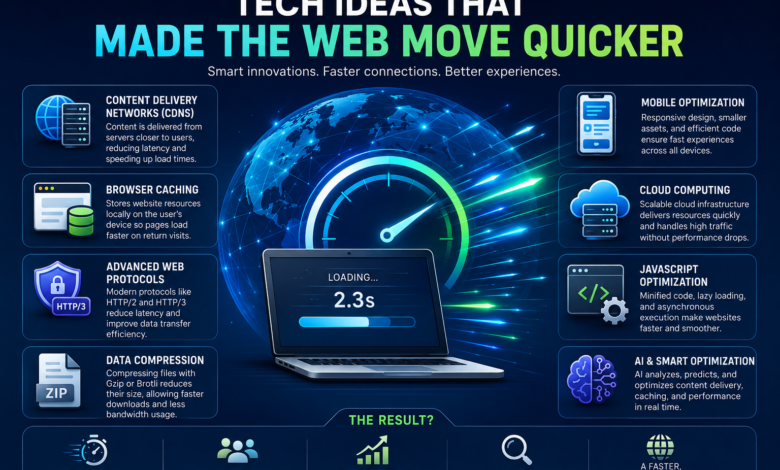
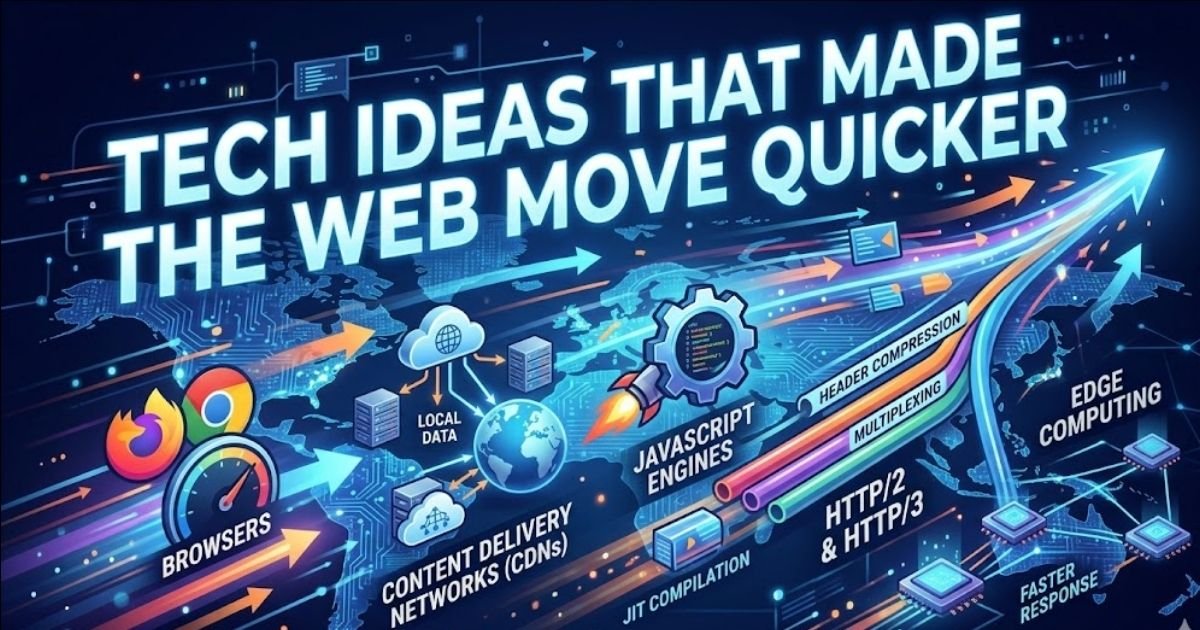
Another groundbreaking idea that made the web faster was the introduction of Content Delivery Networks (CDNs). A CDN is a network of servers distributed across different geographic locations. Instead of serving content from a single central server, websites can deliver data from the server closest to the user.
This approach dramatically reduces latency, which is the delay that occurs when information travels across long distances. When users access a website, images, videos, scripts, and other resources load more quickly because the data comes from a nearby location rather than a distant server.
CDNs have become an essential part of modern web infrastructure. Tech Ideas That Made the Web Move Quicker Major websites, streaming platforms, and online services rely heavily on these networks to ensure fast and reliable content delivery regardless of where users are located.
Browser Caching Improved Loading Speeds
Caching is one of the simplest yet most effective ideas that helped the web move quicker. Browser caching allows frequently used website resources to be stored locally on a user’s device. Instead of downloading the same files repeatedly, the browser retrieves them from local storage.
This process significantly reduces loading times for returning visitors. Tech Ideas That Made the Web Move Quicker Elements such as logos, style sheets, JavaScript files, and images can be reused without requiring another network request. As a result, websites become noticeably faster and consume less bandwidth.
Caching also reduces the workload on web servers. Since fewer requests need to be processed, servers can allocate resources more efficiently and handle larger numbers of users simultaneously.
Advanced Web Protocols Enhanced Communication
The protocols that govern internet communication have evolved considerably over time. Early versions of HTTP served the web well but were not optimized for the demands of modern online experiences. As websites became more complex, new protocols emerged to improve efficiency.
HTTP/2 introduced features such as multiplexing, which allows multiple requests to be sent over a single connection simultaneously. This eliminated many of the bottlenecks associated with older communication methods. Later, HTTP/3 further improved performance by utilizing the QUIC transport protocol.
These innovations reduced latency, minimized connection overhead, and improved overall page loading times. Tech Ideas That Made the Web Move Quicker Modern web applications benefit greatly from these protocol enhancements, delivering faster and smoother experiences for users.
Data Compression Reduced File Sizes
Data compression is another powerful idea that contributed to a quicker web. Large files require more time and bandwidth to transmit across networks. Compression techniques reduce file sizes without significantly affecting quality.
Technologies such as Gzip and Brotli enable websites to compress HTML, CSS, JavaScript, and other assets before sending them to users. Tech Ideas That Made the Web Move Quicker The browser then decompresses the data upon arrival. This process dramatically reduces download times and improves performance, particularly on slower connections.
Image optimization has also played a major role. Modern image formats provide high visual quality while maintaining smaller file sizes. As a result, websites can display rich visual content without sacrificing speed.
Mobile Optimization Accelerated User Experiences
As smartphones became increasingly popular, web developers recognized the need to optimize websites for mobile devices. Mobile optimization emerged as a critical idea for improving web performance across diverse hardware and network conditions.
Responsive design techniques ensure that websites adapt efficiently to different screen sizes. Tech Ideas That Made the Web Move Quicker Developers also began prioritizing lightweight assets, streamlined code, and faster rendering methods to accommodate mobile users.
These improvements not only benefited smartphone users but also enhanced performance for everyone. Mobile-first development practices encouraged greater efficiency and helped create faster, more accessible web experiences across all devices.
Cloud Computing Changed Web Infrastructure
Cloud computing introduced a new level of flexibility and scalability to the internet. Instead of relying solely on physical servers located in one place, businesses gained access to distributed cloud infrastructure capable of handling massive workloads.
Cloud platforms allow websites and applications to scale resources dynamically based on demand. Tech Ideas That Made the Web Move Quicker During periods of high traffic, additional computing power can be allocated automatically to maintain performance and prevent slowdowns.
This technological shift has made the web more resilient and responsive. Many of today’s fastest websites rely on cloud-based infrastructure to deliver consistent performance to users around the world.
JavaScript Optimization Improved Interactivity
Modern websites rely heavily on JavaScript to provide interactive features and dynamic content. However, poorly optimized scripts can negatively impact performance. Tech Ideas That Made the Web Move Quicker Recognizing this challenge, developers introduced numerous techniques to improve JavaScript efficiency.
Code minification, lazy loading, asynchronous execution, and module bundling all contribute to faster page rendering. Modern JavaScript engines within browsers are also significantly more powerful than their predecessors.
These advancements allow websites to deliver rich functionality without compromising speed. Users can interact with applications, forms, and multimedia content more smoothly than ever before.
Search Engine Performance Standards Encouraged Faster Websites
Search engines have played an important role in promoting web speed. Tech Ideas That Made the Web Move Quicker As user expectations increased, search platforms began incorporating page performance into their ranking considerations.
Metrics such as loading speed, responsiveness, and visual stability became important indicators of website quality. Businesses seeking better visibility in search results were motivated to improve their site’s performance.
This emphasis on speed encouraged widespread adoption of best practices, including optimized images, efficient coding techniques, and improved server configurations. Tech Ideas That Made the Web Move Quicker As a result, the overall quality and speed of the web improved significantly.
Artificial Intelligence Is Shaping the Future of Web Speed
Artificial intelligence is becoming an increasingly important factor in web performance optimization. AI-driven systems can analyze user behavior, predict content needs, and optimize resource delivery in real time.
Machine learning algorithms help identify performance bottlenecks, automate image optimization, and improve caching strategies. Some platforms even use predictive loading techniques to prepare content before users request it.
As AI technology continues to evolve, it is expected to play an even greater role in making the web faster, smarter, and more responsive. The next generation of internet experiences will likely be powered by intelligent systems that continuously optimize performance behind the scenes.
Conclusion
The journey toward a faster internet has been driven by countless innovative ideas and technological breakthroughs. From broadband connectivity and content delivery networks to advanced protocols, cloud computing, and artificial intelligence, each innovation has contributed to a quicker and more efficient web.
These technologies have transformed the way people access information, communicate, shop, learn, and entertain themselves online. What once seemed impossible is now a standard expectation: instant access to content from virtually anywhere in the world.
As technology continues to evolve, new ideas will emerge to further enhance web performance. The innovations that made the web move quicker serve as a reminder that progress in technology is often built upon a series of smart, practical solutions that collectively reshape the digital world.